Precision Milling & Turning of 6061, 7075, 2024, 5052 & A380 Aluminum Alloys — Fast Turnaround, Tight Tolerances
Get a Free QuoteWe stock and machine the most widely used aluminum alloys for CNC parts. Each alloy is selected for specific performance characteristics — from general-purpose 6061 to aerospace-grade 7075. Our aluminum CNC machining service covers prototypes through production volumes in all five grades.
| Alloy | Tensile Strength | Hardness (Brinell) | Machinability | Corrosion Resistance | Best For |
|---|---|---|---|---|---|
| 6061-T6 | 310 MPa | 95 HB | Excellent | Good | General purpose, structural, fixtures |
| 7075-T6 | 572 MPa | 150 HB | Good | Moderate | Aerospace, high-stress, tooling |
| 2024-T3 | 483 MPa | 120 HB | Good | Low | Aerospace skins, fatigue-critical parts |
| 5052-H32 | 228 MPa | 60 HB | Good | Excellent | Marine, chemical, sheet metal parts |
| A380 (Cast) | 324 MPa | 80 HB | Good | Good | Die-cast housings, secondary machining |
Not sure which alloy to choose? Send us your application requirements and our engineers will recommend the optimal aluminum grade for your CNC machined parts.
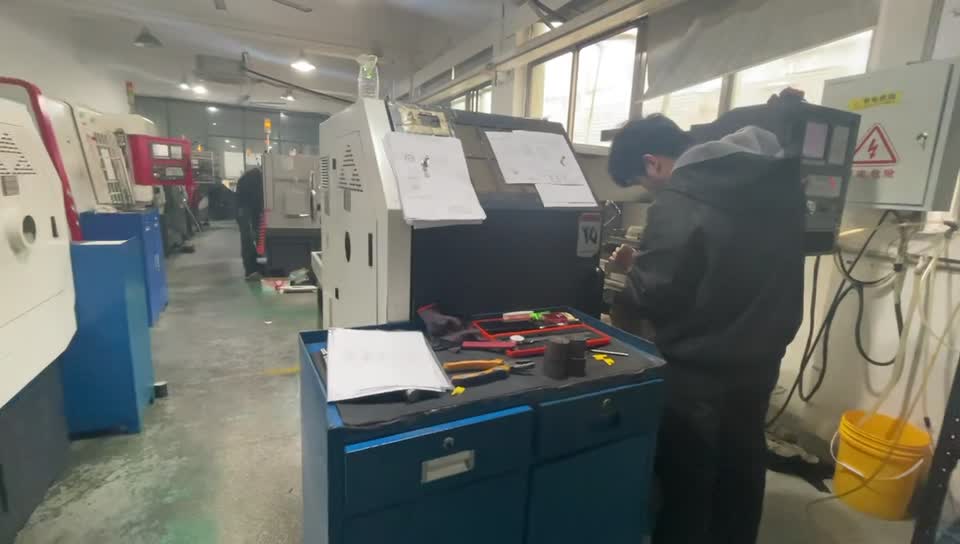
Our aluminum CNC machining capabilities span 3-axis milling through 5-axis simultaneous machining, CNC turning, and precision grinding. Aluminum's excellent machinability allows us to achieve tighter tolerances at lower cost and faster cycle times compared to steel or titanium.
High-speed CNC milling on vertical and horizontal machining centers. 5-axis simultaneous capability for complex contours, undercuts, and multi-face machining in a single setup — reducing lead time and improving accuracy.
CNC lathes with live tooling for rotational aluminum parts. Shafts, bushings, connectors, and cylindrical housings machined complete in one operation — turning, drilling, and milling without re-fixturing.
Accurate hole-making for aluminum assemblies. Deep-hole drilling, reaming, counterboring, and thread tapping (metric and imperial) on CNC machining centers with programmed depth control.
Aluminum accepts a wide range of surface treatments. We handle finishing in-house or through certified local partners, ensuring quality control from raw machining to final coating. Every aluminum CNC machining project includes your choice of finish.
Sulfuric acid anodizing producing a 5-25 micron oxide layer. Available in clear, black, red, blue, gold, and custom colors. Provides corrosion protection, wear resistance, and a professional appearance. Ideal for consumer products and enclosures.
Hard anodizing producing a dense 25-75 micron oxide layer with hardness up to 70 HRC equivalent. Exceptional wear and abrasion resistance for functional parts. Used in aerospace, military, and high-wear industrial applications.
Electrostatically applied dry powder cured under heat. Available in any RAL color with gloss, matte, or textured finishes. Thicker and more durable than liquid paint. Excellent UV and chemical resistance for outdoor applications.
Chromate conversion coating (MIL-DTL-5541, Alodine) provides corrosion protection and paint adhesion in a thin, conductive layer. Bead blasting creates a uniform matte texture, hiding machining marks for a clean, professional look. Both finishes are often combined.
Aluminum CNC machined parts are used across virtually every manufacturing sector. Our cnc machining aluminum capabilities serve industries where precision, lightweight design, and fast turnaround are critical.
Structural brackets, avionics housings, heat sinks, and flight-critical components in 7075-T6 and 2024-T3 aluminum. We understand AS9100 requirements and provide full traceability with material certificates. Tight tolerances and hard anodize finishes are standard for aerospace aluminum CNC parts.
Lightweight aluminum components for powertrain, suspension, and interior applications. From prototype brackets to production intake manifolds, our aluminum CNC machining delivers the dimensional accuracy and surface quality that automotive OEMs and tier-1 suppliers require.
Aluminum is the material of choice for electronic enclosures, heat sinks, and RF shielding due to its thermal conductivity and EMI shielding properties. We machine complex fin geometries, tight-tolerance mounting features, and cosmetic surfaces for consumer and industrial electronics.
Anodized aluminum parts for consumer devices, sporting goods, and medical instruments. Type II anodizing in custom colors delivers the premium look that consumer brands demand. Medical device components benefit from aluminum's biocompatibility and ease of sterilization.
Aluminum is one of the most CNC-friendly metals available. Its combination of low density, high machinability, and excellent thermal properties makes it the go-to material for engineers who need precision parts delivered fast and at competitive cost. Here is why aluminum CNC machining outperforms alternatives for many applications.
3-5x faster machining than steel — aluminum's softness allows higher spindle speeds and feed rates, cutting production time and cost per part significantly
One-third the weight of steel — critical for aerospace, automotive, drone, and portable device applications where every gram matters
Excellent thermal conductivity (167 W/mK for 6061) — ideal for heat sinks, thermal management, and electronics cooling applications
Natural corrosion resistance — aluminum forms a protective oxide layer; anodizing enhances this further for demanding environments
Lower tooling cost — reduced tool wear means fewer tool changes, lower consumable costs, and more consistent part quality across long runs
Versatile finishing options — anodizing, powder coat, chromate, polish, bead blast — aluminum accepts more finish types than almost any other metal
Designing for aluminum CNC machining requires understanding the material's strengths and limitations. Follow these guidelines to reduce cost, improve quality, and shorten lead time on your aluminum CNC machine projects.
Minimum recommended wall thickness for aluminum is 0.5mm, but 1.0mm or greater is preferred for structural integrity. Thin walls can deflect under cutting forces, causing chatter and dimensional variation. Add ribs or fillets for support on walls below 1.5mm.
All internal corners will have a radius equal to the cutter radius. Design internal corners with a minimum radius of 1mm (ideally 1.5mm or larger). Sharp internal corners require EDM, which adds cost. Specify the largest acceptable radius to reduce machining time.
Standard drilled holes should not exceed 10x diameter in depth. For threaded holes in aluminum, specify a thread engagement of 2x diameter minimum (compared to 1.5x for steel) since aluminum is softer. Consider Helicoil inserts for frequently assembled threads.
Standard CNC tolerance is ±0.025mm. Only specify tighter tolerances (±0.01mm) on critical mating surfaces — over-tolerancing increases cost without adding value. Aluminum's thermal expansion (23.6 x 10^-6/K) is higher than steel, so account for temperature in precision assemblies.
As-machined aluminum typically achieves Ra 1.6-3.2. Specify Ra 0.8 only where functionally needed (sealing surfaces, bearing bores). Mirror polish (Ra 0.1) is possible but expensive. For cosmetic parts, bead blasting followed by anodizing is the most cost-effective approach.
If anodizing is planned, avoid mixing alloys in a single assembly (different alloys anodize to different colors). Specify 6061 or 6063 for the best color consistency. Account for the anodize layer thickness (5-25 microns per side for Type II) in tight-tolerance features.
A European electronics company needed a complex aluminum heat sink enclosure for a new industrial IoT gateway. The design featured 42 thin cooling fins (1.2mm thick, 35mm tall), multiple PCB mounting bosses, and a precision-machined sealing groove for an IP65 gasket.
6061-T6 is the most popular alloy for CNC machining due to its excellent machinability, good strength, and corrosion resistance. 7075-T6 is preferred for aerospace and high-stress applications. 2024 offers superior fatigue resistance, while 5052 is ideal for marine and chemical environments. A380 is a cast aluminum alloy used for complex die-cast housings that require secondary CNC finishing.
Our standard tolerance for aluminum CNC machining is ±0.025mm (0.001 inch). For critical dimensions we can achieve ±0.01mm (0.0004 inch). Geometric tolerances including flatness, concentricity, and perpendicularity are held to comparable precision depending on part geometry and size.
Aluminum CNC machining costs depend on part complexity, tolerances, quantity, and surface finish. Simple parts start around $5-15 per piece in batch quantities. Complex aerospace components with tight tolerances and anodizing cost more. Aluminum machines 3-5x faster than steel, making it one of the most cost-effective metals for CNC work. Request a quote with your CAD file for an exact price.
We offer Type II anodizing (decorative, 5-25 microns, multiple colors), Type III hard anodizing (wear-resistant, 25-75 microns), chromate conversion coating (MIL-DTL-5541), powder coating (RAL colors), bead blasting, brushing, polishing, and as-machined finishes. Multiple finishes can be combined on a single part.
Standard lead time is 5-7 business days for prototypes (1-10 pieces) and 10-15 business days for production batches (100+ pieces). Expedited 3-day turnaround is available for simple geometries. Surface finishing adds 2-3 days. Lead times are confirmed at quoting based on current shop capacity.
Yes, our CNC milling centers accommodate parts up to 1000mm x 600mm x 500mm. CNC lathes handle diameters up to 400mm. For oversized parts, we can discuss multi-setup machining or fixture design to achieve the required dimensions.
Aluminum is roughly one-third the weight of steel, machines 3-5x faster (lower cost per part), has excellent thermal and electrical conductivity, and naturally resists corrosion. Steel is stronger and harder, making it better for high-load structural applications. Aluminum is ideal when weight reduction, thermal management, or faster production is the priority.
Yes, we provide material test certificates (MTC) for all aluminum stock, dimensional inspection reports (CMM available), and first article inspection reports (FAIR) upon request. Certificates of conformance are included with every shipment.
We accept STEP (.stp), IGES (.igs), SolidWorks (.sldprt), Parasolid (.x_t), and PDF drawings. For the fastest and most accurate quote, send a 3D STEP file with a 2D drawing showing critical dimensions, tolerances, and surface finish callouts.
Yes, we offer complete manufacturing under one roof. Aluminum CNC parts can be combined with injection mold making and EDM machining, 3D printed metal components, and assembly. This single-source approach reduces lead time and ensures quality consistency across all processes.
Send your CAD file or drawing. We will quote your aluminum parts within 24 hours — including material, machining, surface finish, and shipping. No minimum order quantity.
WhatsApp · WeChat · Global Shipping
Complete mold machining and plastic parts manufacturing — CNC milling, EDM, WEDM, and injection molding in-house.
Learn More →Precision aerospace components in aluminum, titanium, and stainless steel with full traceability and inspection.
Learn More →Send your CAD files and specifications. We respond within 24 hours with a detailed quote for your aluminum CNC parts.
Contact Us →