If you are sourcing conformal cooling inserts, you have almost certainly encountered two terms: SLM and DMLS. Both are laser powder bed fusion (LPBF) processes. Both produce metal parts from powder. Both are used to manufacture conformal cooling inserts for injection molds. But they are not identical — and the differences matter when the part you are printing must survive millions of injection molding cycles at clamping pressures exceeding 100 MPa while transferring heat through internal cooling channels at rates that conventional tooling cannot match.
This article explains what each process is, how they differ technically, and why one is preferred over the other for conformal cooling tooling. We also cover the specific machines MouldNova operates, the post-processing workflow that applies equally to both processes, and the material options available for each.
1. What Is SLM (Selective Laser Melting)?
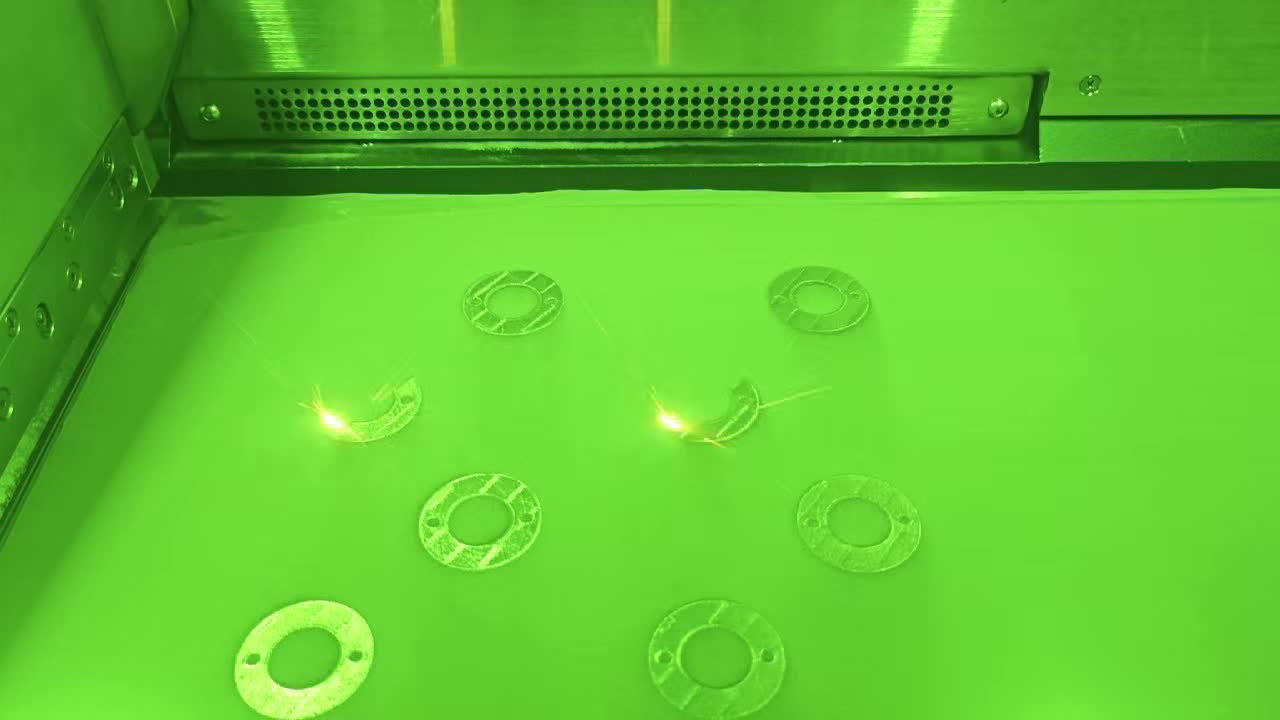
Selective Laser Melting (SLM) is a laser powder bed fusion process in which a high-power fiber laser (typically 200–1,000W) fully melts metal powder particles, layer by layer, to build a solid metal part. The key word is "melts" — the laser input energy is sufficient to raise the powder above its liquidus temperature, creating a true melt pool that solidifies into a fully dense solid.
How SLM Works — Step by Step
- Powder spreading: A recoater blade deposits a thin layer of metal powder (typically 20–50 μm) across the build plate.
- Laser scanning: A fiber laser scans the cross-sectional geometry of the part. The laser energy fully melts the powder, forming a melt pool that fuses with the layer below.
- Layer solidification: The melt pool solidifies within milliseconds. The build plate lowers by one layer thickness (20–50 μm).
- Repeat: The process repeats — spread, scan, solidify — for thousands of layers until the part is complete.
- Post-processing: The completed part is removed from the build plate (typically by wire EDM), heat-treated, and CNC-machined to final dimensions.
Key Characteristics of SLM
- Part density: >99.5% — approaching theoretical maximum. Internal porosity is minimal (<0.5%), which is critical for pressure-bearing cooling channels.
- Microstructure: Fine-grained, homogeneous. Comparable to wrought material after appropriate heat treatment.
- Mechanical properties: Tensile strength, yield strength, and hardness match or exceed wrought equivalents. For maraging steel 1.2709 (MS1/18Ni-300), SLM achieves 1,100–1,200 MPa tensile strength and 50–54 HRC after aging.
- Thermal conductivity: Full density means no porosity-driven reduction in thermal conductivity. This is essential for conformal cooling performance — every percentage point of porosity reduces effective thermal conductivity.
For conformal cooling inserts, the >99.5% density achieved by SLM is not a marketing specification — it is a functional requirement. Internal porosity in a cooling channel wall creates a leak path for pressurized coolant at 3–6 bar. SLM eliminates this risk.
2. What Is DMLS (Direct Metal Laser Sintering)?
Direct Metal Laser Sintering (DMLS) is a term originally trademarked by EOS GmbH to describe their laser powder bed fusion process. In its original definition, DMLS referred to a process that sintered — rather than fully melted — metal powder particles. Sintering fuses particles together at temperatures below the material's melting point, creating solid bonds through diffusion rather than complete liquefaction.
Sintering vs. Melting — The Historical Distinction
In the 1990s and early 2000s, DMLS machines operated at lower laser powers (50–200W) and used powder blends with low-melting-point binder phases. The laser heated the powder enough to cause particle surfaces to fuse through solid-state diffusion, but the core of each particle remained solid. This produced parts with:
- Part density: 85–95% — significant residual porosity.
- Mechanical properties: Lower tensile strength and hardness compared to wrought material. Parts often required infiltration (filling pores with a lower-melting-point metal like bronze) to achieve usable density.
- Surface quality: Rougher surface finish due to partially fused particles.
Modern DMLS — The Convergence with SLM
This is where the terminology becomes confusing: modern EOS machines labeled as "DMLS" actually operate in a full-melting mode. Current-generation EOS systems (M290, M300-4, M400-4) use 400W–1,000W fiber lasers that fully melt single-component metal powders — the same physical process as SLM. The density achieved by these machines is >99% and, in many cases, >99.5%.
The term "DMLS" has therefore become a brand name for EOS's LPBF process rather than a description of a distinct sintering mechanism. When a supplier says they use "DMLS," what matters is not the label but the actual process parameters: laser power, scan strategy, powder type, and resulting part density. If the machine fully melts the powder and achieves >99.5% density, the process is functionally equivalent to SLM regardless of what it is called.
When EOS calls their process "DMLS," they are referring to full-melting LPBF — which is physically identical to what other manufacturers call "SLM." The original sintering-based DMLS process with 85–95% density is obsolete for tooling applications. Any conformal cooling insert supplier using modern equipment is performing full melting, regardless of whether they label it SLM or DMLS.
3. The Core Difference: Full Melting vs. Sintering
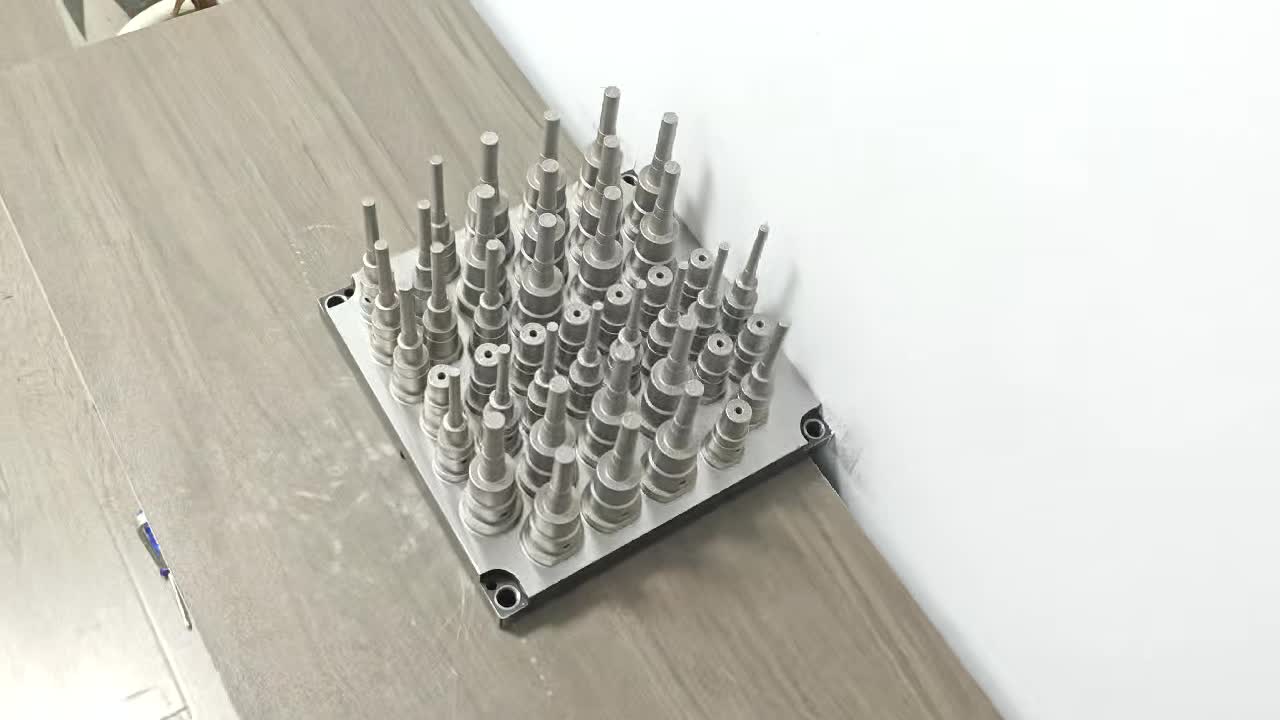
The fundamental physics are different. Understanding this distinction is important because it explains why SLM (full melting) produces superior results for tooling applications — and why legacy DMLS (true sintering) is no longer used for conformal cooling inserts.
Why Density Matters for Conformal Cooling
Conformal cooling channels operate under specific conditions that make density a non-negotiable specification:
- Coolant pressure: 3–6 bar internally. Porous channel walls will leak coolant into the mold cavity — contaminating the plastic part and causing cosmetic defects.
- Injection pressure: 50–150 MPa externally. The insert must withstand millions of high-pressure cycles without fatigue cracking. Porosity acts as crack initiation sites.
- Thermal cycling: Every injection cycle heats the cavity surface to 150–300°C and cools it back to 20–80°C. Thermal fatigue accumulates over millions of cycles. Porous material fails earlier.
- Thermal conductivity: Porosity reduces effective thermal conductivity. A 5% porous insert transfers heat 8–12% less efficiently than a fully dense insert — directly reducing the cooling benefit that justified the conformal design.
For these reasons, only full-melting processes (SLM, or modern DMLS operating in full-melt mode) are suitable for conformal cooling inserts. True sintering-based processes are used today primarily for non-structural prototypes and filter elements where porosity is a feature, not a defect.
4. Head-to-Head Comparison: SLM vs DMLS for Conformal Cooling
The table below compares SLM and DMLS across the parameters that matter most for conformal cooling insert production. "DMLS (legacy)" refers to the original sintering process; "DMLS (modern)" refers to current EOS full-melting systems.
| Parameter | SLM | DMLS (Modern / EOS) | DMLS (Legacy Sintering) |
|---|---|---|---|
| Part density | >99.5% | >99.0–99.5% | 85–95% |
| Tensile strength (MS1, aged) | 1,100–1,200 MPa | 1,050–1,150 MPa | 700–900 MPa |
| Hardness (MS1, aged) | 50–54 HRC | 48–52 HRC | 35–42 HRC |
| Surface roughness (as-built) | Ra 6–12 μm | Ra 7–15 μm | Ra 15–25 μm |
| Thermal conductivity (MS1) | ~20 W/m·K | ~19–20 W/m·K | ~14–17 W/m·K |
| Typical layer thickness | 20–50 μm | 20–60 μm | 40–100 μm |
| Build speed (volumetric) | 5–20 cm³/hr (single laser) | 5–15 cm³/hr (single laser) | 3–8 cm³/hr |
| Multi-laser capability | Up to 4–12 lasers (BLT, SLM Solutions) | Up to 4 lasers (EOS M300-4, M400-4) | Single laser only |
| Coolant leak risk | Negligible (<0.5% porosity) | Very low (<1% porosity) | High — infiltration required |
| Mold life expectancy | >1 million shots | >1 million shots | 200k–500k shots |
| Cost per insert (relative) | 1.0× (baseline) | 1.05–1.15× | 0.7–0.85× (but inferior quality) |
| Suitable for conformal cooling? | Yes — preferred | Yes — equivalent when fully melting | No — obsolete for tooling |
The practical takeaway: if a supplier is using a modern laser powder bed fusion system at 400W+ with single-component tool steel powder and achieving >99% density, the insert quality is equivalent whether they call the process SLM or DMLS. Ask for the density test report, not the process label.
5. Which Process Is Better for Conformal Cooling Inserts?
SLM is the preferred process for conformal cooling inserts. This is not because SLM is inherently a better technology than modern DMLS — as established above, modern DMLS from EOS is functionally the same process. The preference for "SLM" comes down to three practical factors in the tooling supply chain:
Factor 1: Density Guarantee
SLM was defined from the outset as a full-melting process. There is no ambiguity about whether the powder is being sintered or melted. When you specify "SLM process" in a purchase order, the supplier understands that >99.5% density is the baseline expectation. The term "DMLS" carries historical baggage — a buyer unfamiliar with the process evolution might inadvertently accept a sintered part at 95% density. In procurement, clarity of terminology prevents quality escapes.
Factor 2: Machine Availability and Cost in China
The majority of conformal cooling insert production for global export originates in China, where the installed base of SLM machines (BLT, E-Plus, Farsoon, Hans Laser) significantly outnumbers EOS DMLS installations. BLT alone has deployed over 1,200 industrial SLM systems in China. This installed base means:
- Lower operating cost: Chinese-manufactured SLM machines have 40–60% lower capital cost than equivalent EOS systems, translating to 15–25% lower per-hour machine rates.
- Faster lead time: More machines available means shorter queue times. MouldNova typically starts builds within 1–2 business days of design approval.
- Established process parameters: BLT and E-Plus machines have been running maraging steel 1.2709 for conformal cooling since 2018. Process parameters for tool steel are mature and validated across thousands of production inserts.
Factor 3: Multi-Laser Productivity
For large conformal cooling inserts (build heights >200 mm), multi-laser SLM machines offer a significant productivity advantage. The BLT A320 runs dual 500W lasers scanning simultaneously, cutting build time by 30–40% compared to single-laser systems. SLM Solutions' NXG XII 600 deploys 12 lasers — though this scale is primarily used for aerospace, not tooling. In the tooling segment, dual- and quad-laser SLM machines from BLT and E-Plus are the most commonly used configurations.
MouldNova operates BLT A320 and E-Plus EP-M260 SLM machines exclusively. Every conformal cooling insert we produce is printed using full-melting SLM parameters with maraging steel 1.2709 powder. We provide density test reports (Archimedes method or CT scan) with every order. Our standard density specification is >99.5%. If your application requires verification, we can provide cross-section metallography showing the microstructure at the cooling channel wall.
6. Machine Brands: BLT, EOS, SLM Solutions, Trumpf
The metal AM machine market for tooling applications is dominated by four manufacturers. Each has different strengths. Understanding the landscape helps you evaluate your supplier's capability.
| Manufacturer | Process Label | Key Machines for Tooling | Build Volume | Laser Config | Strengths for Conformal Cooling |
|---|---|---|---|---|---|
| BLT (Bright Laser Technologies) | SLM | BLT A320, BLT S310, BLT S450 | 320×320×400 mm (A320) | Dual 500W | Largest installed base in China; mature MS1 parameters; cost-effective for production tooling |
| E-Plus (Eplus3D) | SLM | EP-M260, EP-M450 | 260×260×390 mm (EP-M260) | Single/dual 500W | Precision focus; excellent beam quality for fine channel features; strong in China tooling market |
| EOS | DMLS | M290, M300-4, M400-4 | 250×250×325 mm (M290) | 1–4× 400W | Widest material database; best-documented process parameters; preferred by European toolmakers |
| SLM Solutions | SLM | SLM 280, SLM 500, NXG XII 600 | 280×280×365 mm (SLM 280) | 1–4× 700W | High laser power for fast builds; strong in European/US aerospace but also used for tooling |
| Trumpf | LMF (Laser Metal Fusion) | TruPrint 1000, TruPrint 3000, TruPrint 5000 | 300×300×400 mm (TruPrint 3000) | 1–3× 500W | Excellent beam quality from in-house fiber lasers; green laser option for copper processing |
Which Machines Does MouldNova Use?
MouldNova operates two primary machine platforms for conformal cooling insert production:
Build volume: 320 × 320 × 400 mm — sufficient for the vast majority of conformal cooling inserts including large automotive core inserts.
Laser configuration: Dual 500W fiber lasers with full build-plate overlap, enabling simultaneous scanning for 30–40% faster build times.
Layer thickness: 20–50 μm selectable. We typically run 30 μm for conformal cooling inserts — balancing build speed with surface quality on internal channels.
Atmosphere: Argon inert gas at <100 ppm O₂. Critical for maraging steel to prevent oxide inclusions in channel walls.
Build volume: 260 × 260 × 390 mm — optimized for smaller inserts and multi-insert batch builds.
Beam quality: Excellent Gaussian beam profile for fine feature resolution. Cooling channels as small as 1.5 mm internal diameter with 0.8 mm wall thickness are achievable.
Use case: Electronics connectors, medical device inserts, small-cavity conformal cores where channel geometry requires high precision.
7. Post-Processing: CNC, EDM, Heat Treatment, Polishing
Post-processing is identical for SLM and modern DMLS parts. This is an important cost consideration: the printing step accounts for only 30–45% of the total conformal cooling insert cost. The remaining 55–70% is post-processing. Choosing between SLM and DMLS does not change your post-processing requirements or costs.
The 5-Step Post-Processing Workflow
| Step | Process | Purpose | Typical Tolerance / Spec | Cost Share |
|---|---|---|---|---|
| 1 | Stress relief / aging heat treatment | Relieve residual thermal stress from printing; age-harden maraging steel to target hardness | 490°C × 6 hr (MS1 aging); vacuum or argon atmosphere | 8–12% |
| 2 | Wire EDM — build plate separation | Separate printed insert from steel build plate | ±0.05 mm on cut plane | 3–5% |
| 3 | CNC milling & grinding | Machine all mating surfaces, datum features, and shut-off faces to final dimensions | ±0.01–0.02 mm on critical surfaces | 25–35% |
| 4 | Wire / sinker EDM — fine features | Machine internal details, sharp corners, and features that CNC cannot reach | ±0.005–0.01 mm (wire EDM) | 10–18% |
| 5 | Surface polishing | Polish cavity-facing surfaces to required finish for part cosmetics | SPI A-2 (Ra ≤ 0.05 μm) to SPI B-1 (Ra ≤ 0.5 μm) | 5–12% |
Additional steps may include pressure testing of cooling channels (typically 8–10 bar, 30-minute hold with zero leakage), CMM dimensional inspection, and fitting trials in the mold base. These verification steps add 3–5% to total cost but are standard practice for production tooling.
The post-processing workflow is the same for both SLM and DMLS printed inserts. The only difference is that legacy sintered DMLS parts (85–95% density) sometimes required an additional infiltration step before machining — a step that is unnecessary with modern full-melting processes.
Why Post-Processing Dominates Insert Cost
Metal 3D printing creates a near-net-shape part, but "near-net" is not "net." The as-printed surface roughness of Ra 6–12 μm is acceptable inside cooling channels (where roughness actually enhances turbulent heat transfer) but is far too rough for cavity faces, parting lines, and mating surfaces. CNC machining and polishing bring these surfaces to injection mold specifications. This is unavoidable regardless of the printing process used.
8. Material Compatibility by Process
Both SLM and modern DMLS can process the same range of materials. However, not all materials are equally suitable for conformal cooling inserts. The table below shows the primary materials used in tooling applications and their availability on each platform.
| Material | Designation | SLM Availability | DMLS (EOS) Availability | Suitability for Conformal Cooling | Key Properties |
|---|---|---|---|---|---|
| Maraging steel | 1.2709 / 18Ni-300 / MS1 | All SLM machines | EOS MS1 | Primary choice | 50–54 HRC; excellent polishability; 20 W/m·K thermal conductivity |
| Hot-work tool steel | H13 / 1.2344 | BLT, Farsoon, SLM Solutions | EOS (limited parameters) | Good — higher thermal conductivity | 46–52 HRC; 24–28 W/m·K; requires careful parameter control to avoid cracking |
| Stainless steel | 316L / 1.4404 | All SLM machines | EOS 316L | Niche — corrosive-resin applications | Low hardness (~25 HRC); excellent corrosion resistance; 15 W/m·K |
| CuCrZr copper alloy | CW106C | BLT (green laser), Trumpf | EOS (limited) | Excellent — highest thermal conductivity | ~25 HRC; 320–350 W/m·K; ideal for hot-spot inserts but lower wear resistance |
| Tool steel | Corrax / M789 | Selected SLM machines | EOS (well-documented) | Good — corrosion-resistant mold steel | 50–52 HRC; stainless grade; good for PVC and corrosive resins |
| Conformal copper core | Pure Cu / GRCop-42 | Requires green laser | Requires green laser | Specialty — extreme thermal management | 390–400 W/m·K; very low hardness; used as thermal core within steel shell |
Why Maraging Steel 1.2709 Dominates Conformal Cooling
Over 90% of conformal cooling inserts produced globally use maraging steel 1.2709 (also known as MS1 or 18Ni-300). The reasons are practical:
- Printability: Maraging steel is one of the easiest tool steels to print. It does not crack during solidification (unlike H13, which requires preheating to 200–400°C). This means it can run on standard SLM/DMLS machines without platform modifications.
- Age hardening: It achieves 50–54 HRC through a simple aging treatment at 490°C — no quenching required. The part does not distort during heat treatment, preserving as-printed dimensional accuracy.
- Machinability: In the solution-annealed state (~30 HRC), it machines easily. Parts can be rough-machined before aging, then finish-ground after hardening.
- Weldability: Maraging steel can be welded or brazed to conventional tool steel mold bases without preheating, simplifying integration into existing tooling.
H13 tool steel is gaining adoption for conformal cooling because its thermal conductivity (24–28 W/m·K) is 25–40% higher than maraging steel (20 W/m·K). However, H13 requires build plate preheating to 200–400°C to prevent cracking, which limits it to machines with heated platforms. BLT and EOS both offer H13-capable machines, but process parameter development is less mature than for maraging steel.
9. FAQ
SLM (Selective Laser Melting) fully melts metal powder layer by layer, achieving >99.5% density and near-wrought mechanical properties. DMLS (Direct Metal Laser Sintering) historically referred to a sintering process at 85–95% density, but modern EOS DMLS machines now operate in a full-melting mode identical to SLM. For conformal cooling inserts, the distinction is largely semantic — what matters is that the process achieves >99.5% density to ensure leak-free cooling channels and fatigue resistance over millions of injection cycles.
SLM produces the strongest inserts because full melting creates a homogeneous microstructure with tensile strength of 1,100–1,200 MPa and hardness of 50–54 HRC for maraging steel 1.2709. Modern DMLS (EOS full-melting mode) achieves comparable results at 1,050–1,150 MPa. Legacy sintered DMLS parts were significantly weaker at 700–900 MPa and are not suitable for production tooling. For any new conformal cooling project, specify >99.5% density and >1,050 MPa tensile strength regardless of which process label the supplier uses.
MouldNova operates BLT A320 (320×320×400 mm build volume, dual 500W fiber lasers) and E-Plus EP-M260 (260×260×390 mm build volume) SLM machines. The BLT A320 handles large inserts including automotive core blocks, while the EP-M260 is used for smaller precision inserts such as medical device and electronics connector tooling. Both machines run maraging steel 1.2709 with validated process parameters achieving >99.5% density on every build.
No. Post-processing is identical for both SLM and modern DMLS inserts. The standard workflow is: stress relief / aging heat treatment (490°C × 6 hours for maraging steel), wire EDM to separate the part from the build plate, CNC milling and grinding of mating surfaces to ±0.01 mm, sinker EDM for fine internal features, and surface polishing to the required SPI finish. Post-processing accounts for 55–70% of total insert cost. The only difference is that legacy sintered DMLS parts sometimes required an infiltration step to fill porosity — a step that is unnecessary with modern full-melting processes.
For conformal cooling inserts, the total cost difference between SLM and modern DMLS is typically less than 10%. The printing step accounts for only 30–45% of total insert price — the remainder is post-processing (CNC, EDM, heat treatment, polishing), which is identical for both. In China, where MouldNova operates, SLM machines from BLT and E-Plus have 40–60% lower capital costs than EOS DMLS systems, translating to 5–15% lower printing costs per insert. This is why the majority of conformal cooling inserts exported from China are produced on SLM equipment.
Related Pages
- Conformal Cooling Benefits — Five Benefit Categories with a 3-Year Factory Model
- Conformal Cooling vs Conventional Cooling — Side-by-Side with 13 Real Projects
- Conformal Cooling ROI — Payback Period, Annual Savings & 5-Year NPV Calculator
- Conformal Cooling Inserts — Service Details & Specifications
- Metal 3D Printing Service — SLM Process & Capabilities
- Case Studies — Full Production Data from Real Programs