- Three cost tiers at a glance: $800–3,000 / $3,000–10,000 / $15,000–120,000
- Component-level cost breakdown: print time, powder, post-processing, inspection, logistics
- Detailed price table: 8 insert types with price ranges, lead times, and notes
- What drives price variation — 5 factors with quantified impact
- China vs. US vs. EU landed cost comparison including current tariff regimes
- 3-year total cost of ownership model: conformal vs. conventional
- Honest guidance on when conformal cooling is not worth buying
- How to get an accurate quote + 5 cost reduction strategies
Table of Contents
- Three Cost Tiers at a Glance
- What You're Actually Paying For: Cost by Component
- Price by Insert Type: Detailed Table
- What Drives Price Variation: 5 Factors
- China vs. US/EU Cost Comparison
- Total Cost of Ownership: 3-Year Model
- When Conformal Cooling Cost Doesn't Make Sense
- How to Get an Accurate Quote
- 5 Cost Reduction Strategies
- FAQ
Three Cost Tiers at a Glance
Before getting into the detail, here is the honest answer most suppliers make you chase: conformal cooling cost falls into three tiers based on what you are buying. All prices below are USD, China-sourced, and inclusive of SLM printing, post-processing, quality inspection, and DHL DDP worldwide shipping.
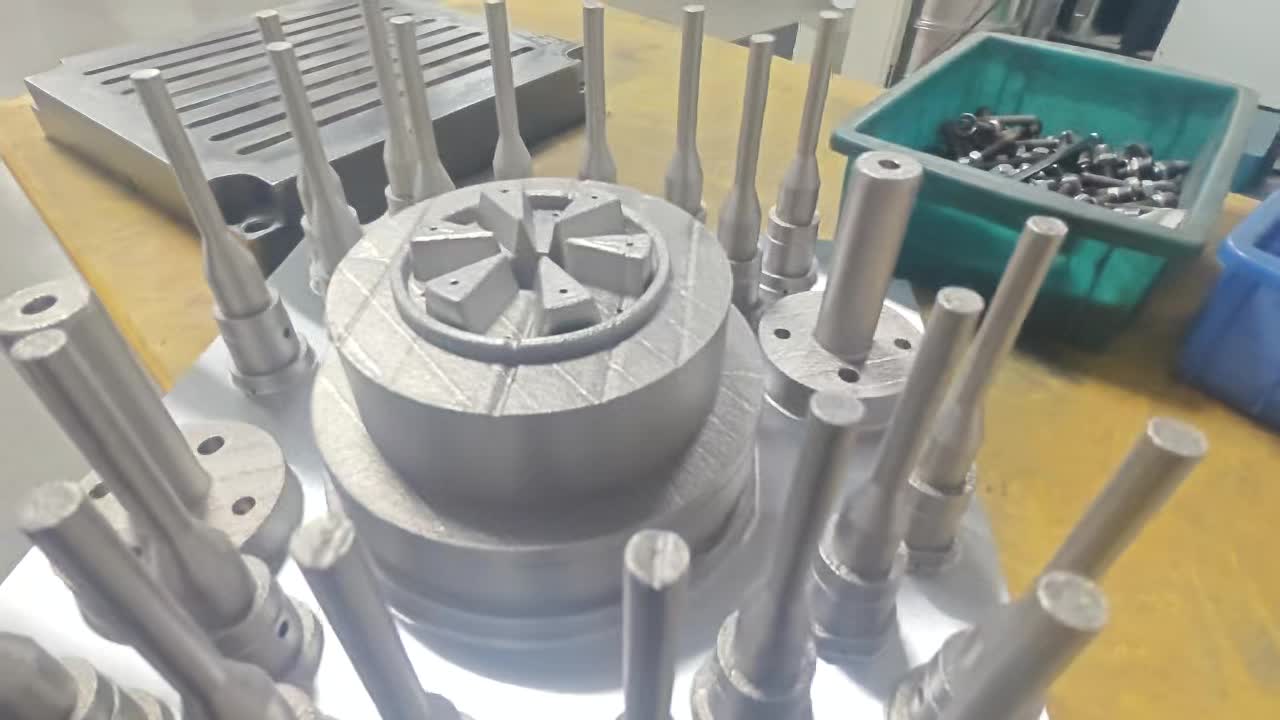
Simple or Flat Insert
Single insert up to ~150×150mm, 420 stainless steel, standard conformal channel geometry, no complex curvature or undercuts. Typical examples: flat cavity plate insert, simple core insert. Ideal as a retrofit insert for an existing mold.
Curved or Multi-Zone Insert
Curved geometry, spiral core channels, multiple cooling circuits, or insert dimensions above 150mm. Includes complex core pins and slide inserts. Most production applications fall here.
Complete Conformal Cooling Mold
Full mold including mold base, runner, ejector, and multiple conformal cooling inserts. Price scales with cavity count and part complexity. 4-cavity mold in 420 SS: $18,000–35,000 typical.
What You're Actually Paying For: Cost by Component
Conformal cooling pricing is not arbitrary. Every dollar in the quote maps to a specific process step. Understanding the cost breakdown tells you whether a quote is complete and where savings are actually achievable.
Engineering & Moldflow Simulation
Channel routing design, wall-distance optimization, Moldflow thermal simulation. Many suppliers (including MouldNova) include this free with every quote. If a supplier charges separately, $200–800 is fair for complex geometry.
LPBF / SLM Print Time
Machine time is the largest single cost line, driven by the LPBF printing process. Build time depends on insert volume and support structure complexity. A 100×100×80mm insert typically builds in 4–7 hours; a large complex insert can run 12–16 hours.
Metal Powder Consumed
420 SS powder: $80–120/kg. 18Ni300 maraging steel: $120–200/kg. CuCrZr: $180–350/kg. Learn more about tool steel options. A 100×100×80mm insert consumes approximately 1.2–2.0 kg of powder including support structures.
Depowdering, Heat Treatment, CNC Finishing
Includes powder evacuation and channel flushing, stress relief anneal (480°C), vacuum hardening to 48–52 HRC, CNC machining of mating surfaces to ±0.05–0.1mm, and cavity face polishing to specified Ra.
Inspection: CMM, Hydrostatic Test, Ra
CMM dimensional report, hardness test (3 points), channel hydrostatic or pneumatic pressure test at 1.5× operating pressure (10-minute hold, zero pressure drop), surface roughness Ra measurement. Material mill cert included.
DHL DDP Worldwide Shipping
DHL Express DDP (Delivered Duty Paid) — all customs clearance and import duties handled, door-to-door. US and India: typically $100–180 for a single insert. EU: $120–220. DDP means no surprise bills on arrival.
Price by Insert Type: Detailed Table
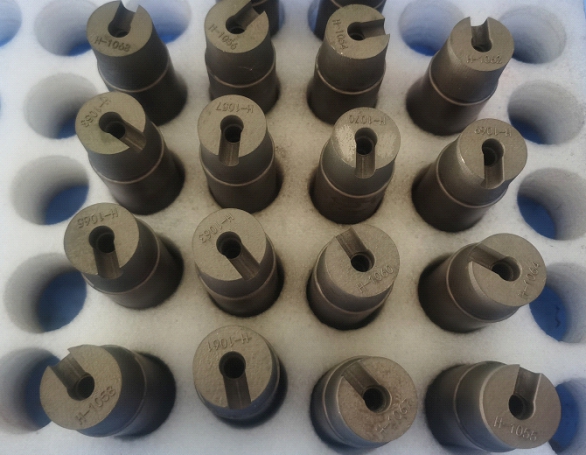
The table below covers the eight most common conformal cooling insert configurations with realistic price ranges based on 420 stainless steel, China LPBF sourcing, DDP to US or India, and the full post-processing and inspection stack described above.
| Insert Type | Typical Size | Price Range (420 SS) | Lead Time | Notes |
|---|---|---|---|---|
| Simple flat cavity insert | 100×100mm | $900 – $1,400 | 10–12 days | Most economical entry point. Minimal channel complexity. Good for flat parts with a clear hotspot. |
| Complex curved insert | 120×150mm | $2,800 – $4,500 | 12–16 days | Contoured cavity face, multi-plane channel routing. Most automotive and consumer product applications. |
| Core pin (small) | < 8mm dia. | $1,200 – $2,200 | 10–14 days | Micro-channel design. High engineering content relative to part size. Often the highest-ROI insert in a mold. |
| Core pin (medium) | 8 – 20mm dia. | $1,800 – $3,200 | 10–14 days | Standard spiral channel design. Bubble-free build critical. Pressure test mandatory. |
| Sprue bushing | Standard or custom | $800 – $1,600 | 8–12 days | Gate-zone cooling. CuCrZr version ($1,600–2,800) recommended for materials requiring fast gate solidification. |
| Slide insert | Varies (50–150mm) | $2,200 – $5,500 | 12–18 days | Complex geometry with sliding interface. Requires precise CNC fitting; higher post-processing content. |
| Full cavity block | 150×200mm+ | $5,500 – $12,000 | 16–22 days | Large-format insert with multi-zone channels. Multiple print runs may be required. Price scales with build volume. |
| Custom shape / hybrid | Customer-defined | Quote required | 14–25 days | Irregular geometry, integrated manifold, or multi-material build. Provide STEP file for accurate pricing. |
What Drives Price Variation: 5 Factors
Two inserts of nominally the same size can carry price tags that are $2,000 apart. Here are the five factors that actually drive the variation, with quantified impact on price.
1. Geometry Complexity
A simple flat insert (planar cavity face, no undercuts, straightforward channel routing) versus a complex curved insert (contoured surface, multi-axis channel paths, tight wall distances in constrained zones) can vary by up to ±40% in both SLM print time and post-processing labor. Geometry complexity is the single largest price driver. Simplifying the channel layout — where performance allows — is the most effective cost lever.
2. Material Choice: 420 SS vs. CuCrZr
420 stainless steel is the baseline material: good strength (up to 52 HRC hardened), adequate thermal conductivity (24 W/m·K), and cost-effective at $80–120/kg powder. CuCrZr delivers 4× higher thermal conductivity (approximately 210 W/m·K) but costs $180–350/kg, prints at slower scan speeds (more machine time), and requires specialized heat treatment. The CuCrZr premium is justified only when the part geometry is extremely dense, cycle time is limited by heat extraction rate not just uniformity, or the processing temperature is above 300°C. For most applications, 420 SS with well-designed channels outperforms CuCrZr with poorly designed channels.
3. Surface Finish Requirement
Ra 3.2μm (standard SLM-as-machined finish) is adequate for many applications. Achieving Ra 1.6μm requires additional polishing passes: add $100–200. Achieving Ra 0.8μm (mirror-adjacent polish suitable for optical or medical parts) requires hand polishing to SPI B1/B2 standard: add $200–400. Specifying a tighter finish than your application requires is one of the easiest ways to overpay. Always specify Ra against the actual part requirement, not the tightest possible value.
4. Order Quantity
Ordering 5 or more identical or near-identical inserts in a single batch produces 15–25% unit price reductions through three mechanisms: (a) multiple parts can share a single build plate, reducing machine time per unit, (b) engineering and setup costs amortize across more pieces, (c) suppliers offer explicit volume pricing at 5+ and 10+ unit breaks. If you run multiple cavities of the same mold, or have repeat tooling with the same insert design, batching is the lowest-effort cost reduction available.
5. Simulation Included vs. Customer-Provided CAD
If you provide a verified STEP file of the mold cavity with ejector pin positions, parting line, and gate location already defined, the engineering team goes straight to channel design. If a supplier needs to run Moldflow from scratch to define where channels should go, add 1–3 engineering days and $200–600. MouldNova includes free Moldflow simulation with every quote — but having clean customer-provided CAD still reduces iteration rounds and compresses lead time regardless of who covers the simulation cost.
China vs. US/EU Cost Comparison
The most common question from US and European buyers is: "How does China sourcing compare on landed cost after tariffs?" The table below uses a representative complex curved insert (420 SS, ~120×150mm) as the reference. All prices are delivered to a US facility or EU facility.
| Supplier Location | Ex-Works Price | Tariff / Duty | DHL Shipping | Landed Cost (US) | Landed Cost (EU) |
|---|---|---|---|---|---|
| China (MouldNova) | $2,200 | US: +20% (Section 301) = $440 EU: +3.7% MFN = $81 |
$150 | $2,790 | $2,431 |
| US LPBF shop | $5,800–6,200 | None | $0 (domestic) | $5,800–6,200 | N/A (domestic US) |
| EU LPBF shop (Germany/BE) | €4,200–5,400 | None (EU domestic) | €0 | $4,600–6,000 (USD equiv.) | €4,200–5,400 |
Lead time differential is also narrower than commonly assumed. MouldNova's standard lead time for a complex insert is 12–16 working days ex-China, plus 2–3 days DHL transit = 14–19 calendar days door-to-door. A US LPBF shop quoting 4–6 weeks for the same insert is not meaningfully faster after accounting for their internal queue.
Total Cost of Ownership: 3-Year Model
Purchase price is only one component of cost. The TCO model below compares a conformal cooling core insert scenario versus a conventional drilled-core scenario over 3 years, using a representative automotive housing part (42-second conventional cycle, 150,000 shots/year, $85/hr machine rate, 1 cavity).
Conventional Cooling — 3-Year TCO
Conformal Cooling — 3-Year TCO
The TCO model compounds further at higher cavity counts. A 4-cavity version of the same mold with conformal cooling in all four cavities (insert cost ~$11,200) generates $212,500/year in machine time savings — a payback measured in weeks, not months.
Get a quote with real numbers for your specific part
Send your STEP file. MouldNova returns a full quote within 24 hours — including a free Moldflow simulation showing projected cycle time improvement and the exact insert price for your geometry.
When Conformal Cooling Cost Doesn't Make Sense
Honest guidance matters here. Conformal cooling is the right answer for a large proportion of injection molding applications — but not all. Here are the three scenarios where the economics clearly do not support the investment:
- Low-volume production (<10,000 shots/year). At 10,000 shots/year and a 35% cycle time reduction, the annual machine time saving on a 42-second part at $85/hr is approximately $3,500. After 3 years the saving is $10,500. That barely covers a simple insert. At 5,000 shots/year the payback stretches to 5+ years. Use conventional cooling or budget tooling for low-volume work.
- Simple flat parts where conventional cooling geometry already works. If your part is a flat disc, a shallow box lid, or any geometry where straight-drilled channels achieve a small channel-to-surface distance uniformly, conventional cooling may already perform at 85–90% of theoretical optimum. A Moldflow baseline simulation will confirm whether there is a meaningful hotspot to solve. If the baseline temperature variation is already ±3–5°C, conformal cooling will not deliver transformative results.
- Prototype or short-run tooling with an intended life under 20,000 shots. For prototype tooling, bridge tooling, or short-run production intended to run fewer than 20,000 shots before design changes, the investment in SLM-printed conformal inserts cannot recover its cost. Use aluminum tooling, soft steel, or P20 with conventional drilling. If the program grows into production volumes, upgrade to conformal cooling at that point.
How to Get an Accurate Quote
Conformal cooling quotes vary enormously depending on what information the supplier has. A quote based on vague descriptions will be either wildly high (supplier baking in risk) or wildly low (supplier guessing optimistically and adding costs later). Here is the five-item checklist that gets you a binding quote on first pass:
-
1STEP file of the mold cavity or insert pocket Include the cavity and core geometry, ejector pin positions, parting line, and gate location. A complete STEP file eliminates the largest source of quote uncertainty. If the design is not final, provide the closest available revision with a note on what may change.
-
2Mold base standard and insert pocket dimensions Specify the mold base standard (DME, HASCO, LKM, or custom) and the nominal insert pocket dimensions. This determines the envelope the insert must fit in and the mating surface tolerances the CNC finishing must achieve. See our tooling specifications guide for standard options.
-
3Working pressure and coolant media The pressure test specification is set at 1.5× operating pressure. Typical mold cooling operates at 4–8 bar. Specify this so the supplier can design the channel wall thickness and confirm the hydrostatic test parameters. Also specify water or oil cooling — this affects channel surface treatment for some materials.
-
4Surface finish specification (Ra value) for the cavity face Specify the required Ra value on the cavity-facing surface of the insert. Ra 1.6–3.2μm is standard for structural and automotive parts. Ra 0.8μm or better is required for optical, cosmetic, and medical applications. Mismatching the finish spec to your actual requirement is one of the easiest ways to overpay.
-
5Annual shot volume and material being molded Annual shot volume drives the payback analysis the supplier will use to validate the recommendation. The molding material (PP, ABS, PA66-GF30, POM, etc.) affects the recommended insert material, channel design parameters, and mold temperature setting — all of which affect price. Without this, any cycle time improvement claim in the quote is speculative.
5 Cost Reduction Strategies
If the initial quote is higher than your target, these five strategies reliably reduce conformal cooling cost without compromising cooling performance.
Standardize geometry across multiple inserts
If your mold has two or four cavities, design the conformal inserts to be geometrically identical (mirror-matched or fully identical). This enables multiple parts per build plate, cutting print time per unit by 30–40% versus printing each insert separately. On a 4-cavity mold, print-plate sharing alone can reduce per-insert cost by $300–600.
Typical saving: 20–30% per insert at 4+ quantityOrder in batches, not one at a time
Volume price breaks typically occur at 5+ and 10+ inserts. If you have multiple mold programs using conformal inserts, batch them into a single order even if the programs are on slightly different timelines. Ordering 6 inserts across two programs in one PO typically saves 18–22% versus two separate 3-insert orders, and the consolidated DHL shipment reduces per-insert shipping cost as well.
Typical saving: 15–25% unit discountUse 420 SS unless CuCrZr is genuinely required
CuCrZr is specified when thermal conductivity is the bottleneck and when the mold operates above 250°C or the part requires very fast gate solidification. For the majority of PP, ABS, and PA applications running at 40–80°C mold temperature, 420 SS with correctly designed channels (8–12mm wall distance, 8mm channel diameter) will capture 90%+ of the theoretical cycle time improvement at 40–60% of the CuCrZr price. Ask your supplier to quantify the ΔT improvement in Moldflow with 420 SS before committing to CuCrZr.
Typical saving: 40–55% versus CuCrZr equivalentSimplify the manifold design
Integrated internal manifolds (where the coolant distribution network is built into the insert body rather than connected via external hoses) are elegant but expensive to design and print. For most inserts, a simple in-out channel design with external fittings delivers equivalent performance at lower cost. Discuss with your supplier whether an integrated manifold is genuinely required for your application, or whether a simpler design achieves the same cooling uniformity.
Typical saving: $200–800 per insert on engineering and print timeProvide a verified STEP file to eliminate design iteration
Every round of design revision adds 1–2 days and $100–300 to the project cost. Providing a STEP file where the cavity geometry, ejector positions, parting line, and gate location are finalized and verified eliminates the back-and-forth. Even if the supplier provides free Moldflow simulation, having clean input data reduces engineering hours on both sides. Run your DFM check internally before sending files, and flag any unresolved design uncertainties explicitly in the RFQ email so the supplier can price them rather than discover them mid-project.
Typical saving: $200–600 in engineering cost + 2–4 days lead timeApply these strategies to your next order — get a real quote in 24 hours
Tell us your insert type, annual volume, and current cycle time. We'll send you a line-item quote, a free Moldflow simulation, and a recommended cost reduction path — all within one business day.
Frequently Asked Questions
How much does conformal cooling cost?
What drives the cost of a conformal cooling insert?
Is China-sourced conformal cooling cheaper than US or EU after tariffs?
When does conformal cooling NOT make economic sense?
What is the fastest way to get an accurate conformal cooling cost estimate?
Related Articles & Pages
- Conformal Cooling Mold: Complete Buyer's Guide — Types, Pricing, Supplier Evaluation
- Conformal Cooling Design: Decision Framework & Application Guide
- Conformal Cooling Channel Design: Parameters & Engineering Workflow
- Conformal Cooling 3D Printing: SLM Process, Materials & Cost Breakdown
- Conformal Cooling in Injection Molding: Cycle Time & ROI Data
- Our Conformal Cooling Insert Service — Get a Quote