Conformal Cooling Mold: Complete Buyer's Guide — Types, Real Pricing, Supplier Evaluation & First Article Inspection
- What makes a mold a conformal cooling mold — system components and how they interact
- Three types of conformal cooling molds and when to use each
- Real price ranges: inserts only, full molds, China vs. Europe/US
- Lead time breakdown by mold type
- Seven questions to ask every supplier — and what good vs. bad answers sound like
- Eight red flags in quotes and supplier conversations
- First article inspection checklist: what to demand before releasing final payment
- Payback calculation: how to build your ROI case internally
Table of Contents
What Makes a Mold a "Conformal Cooling Mold"
The term "conformal cooling mold" is used loosely in the industry. At its most precise, it means an injection mold containing at least one insert with internal cooling channels that conform to the mold cavity surface — following its contours at a constant offset, manufactured via metal 3D printing because no other process can create these geometries.
What a conformal cooling mold is not:
- Not a "better conventional mold" — increasing the number of drilled channels or adding more baffles does not make a mold conformal
- Not the same as a "3D printed mold" — most of a conformal cooling mold is still conventionally machined steel; only the specific conformal insert zones are SLM-printed
- Not necessarily the whole mold — a mold with one conformal cooling core insert and conventional cooling everywhere else is legitimately a conformal cooling mold
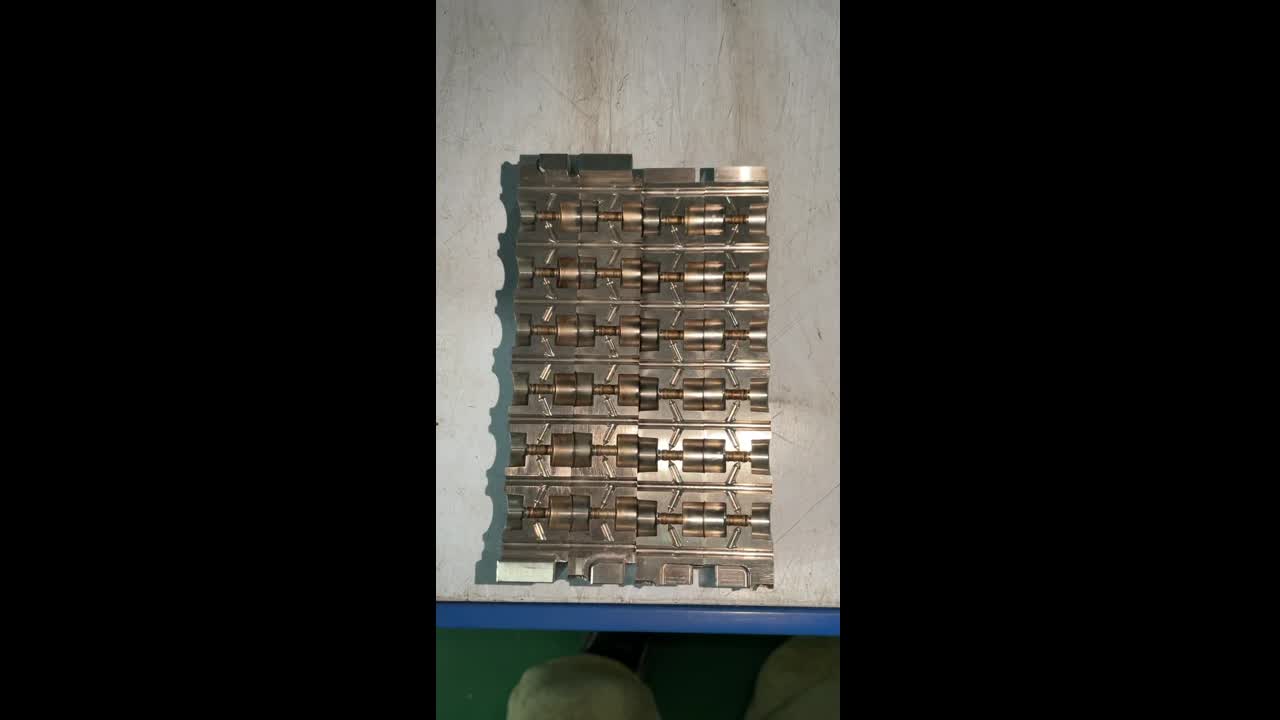
The defining characteristic is the channel geometry: channels that follow the part surface at 8–15mm offset, routed through geometry that no drill can access, manufactured layer by layer via SLM or DMLS.
Three Types of Conformal Cooling Molds
Type 1: Retrofit Conformal Insert
A single conformal insert replaces one problem zone in an existing mold. The mold base, runner, ejector, and all other components remain unchanged. The insert is machined to fit the existing pocket.
Best for: One chronic hotspot in an otherwise functional mold. Most cost-effective entry point. Achieves 70–90% of full conformal performance in that zone.
Type 2: Hybrid New Mold
New mold designed with conformal inserts in the critical zones (deep cores, complex geometry) and conventional drilled channels everywhere else. The mold base is new; only the problem zones use SLM-printed inserts.
Best for: Most production applications. Balances cost and performance optimally. 80% of conformal cooling applications fall here.
Type 3: Full Conformal Mold
Every major mold zone uses conformal cooling — cavity, core, sliders. Designed from scratch for maximum thermal performance. Highest cost, maximum cycle time reduction and part quality.
Best for: Extreme-uniformity applications (optical, medical), high-cavitation automotive tooling, or parts where geometry is uniformly complex with no simple flat zones.
The Complete Mold System: All Components
A conformal cooling mold is a system. The insert is the critical component, but the system performance depends on every element being correctly specified and integrated:
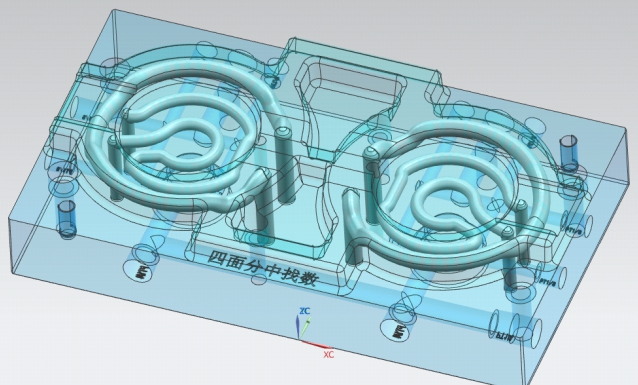
Conformal Cooling Insert(s)
SLM-printed steel or CuCrZr with internal 3D channel geometry. The only component that must be additive manufactured. All thermal performance flows from this insert's channel design and material.
Mold Base
Conventionally machined P20 or H13 steel. Houses the conformal inserts in precision-toleranced pockets (±0.02mm). Routes coolant inlet/outlet connections to the insert fittings.
Temperature Controller / Chiller
Water or oil TCU maintains coolant at target temperature. Must provide ≥6 L/min per 8mm channel circuit at >4 bar. Undersized chiller negates conformal insert performance.
Manifold & Hose Assembly
Full-bore manifold distributes flow to parallel circuits. Hose ID must equal or exceed channel diameter. Flow meters and pressure gauges on each circuit for monitoring.
Hot Runner or Cold Runner
Gating system is independent of conformal cooling but interacts with it. Gate area often benefits from a targeted CuCrZr conformal insert regardless of overall runner type.
Ejector System
Pin locations must be provided to the conformal designer before channel routing — they create no-go zones for channel paths. Ejector pin pattern constrains where channels can go.
Moldflow / Thermal Simulation
Not a physical component but a required design input. Baseline hotspot analysis defines where conformal inserts go and what the channel parameters should be. Don't design without it.
Mold Temperature Monitoring
Thermocouples embedded near critical zones confirm actual mold surface temperature during production. Enables proactive detection of cooling degradation before it affects part quality.
Real Price Ranges
Conformal cooling pricing varies significantly by geography, supplier capability, and mold complexity. Below are realistic price ranges based on our production data and market knowledge, in USD:
Conformal cooling inserts (supply only, no full mold)
China-sourced inserts (full-service: SLM print + post-process + inspection)
European / North American sourced inserts
Full conformal cooling molds (complete, including mold base)
| Mold Type | China (full-service) | Europe / North America | Cavities |
|---|---|---|---|
| Simple single-cavity + 1 conformal insert | $15,000–25,000 | $35,000–65,000 | 1 |
| Medium hybrid mold, 2–4 conformal inserts | $25,000–45,000 | $60,000–110,000 | 1–4 |
| Complex automotive — multi-cavity, full conformal | $45,000–90,000 | $110,000–220,000+ | 4–16 |
| High-cavitation packaging (32–96 cavity) | $80,000–200,000 | $200,000–500,000+ | 32–96 |
Lead Time Breakdown
For a full new mold, the mold base machining (typically 15–25 days) runs in parallel with insert manufacturing. The critical path is usually the mold base, not the insert. Total mold lead time including T1 trial shots:
| Mold Type | Total Lead Time (to T1 shots) | Bottleneck |
|---|---|---|
| Retrofit insert only | 10–16 working days | Post-processing (CNC + heat treatment) |
| Simple hybrid mold (1–2 inserts) | 30–42 working days | Mold base machining |
| Medium hybrid mold (3–6 inserts) | 40–55 working days | Mold base + insert lead times parallel |
| Complex full conformal mold | 55–70 working days | Multiple SLM print batches + complex fitting |
Want a quote with a lead time guarantee in writing?
Every MouldNova quote includes a committed ship date. We put it in the confirmation email and we honor it. Send your files and we'll quote within 24 hours.
Seven Questions to Ask Every Supplier
Is the SLM printing done in-house or outsourced?
What material is the conformal insert, and why that choice for my part?
Can you show me the Moldflow simulation before and after conformal cooling?
What is the wall distance from channel centerline to cavity surface?
How do you pressure-test the channels before shipping?
What post-processing steps are included — and to what standard?
What does your first article inspection package include?
Eight Red Flags to Watch For
🚩 Cycle time claims without simulation
"30–70% reduction guaranteed" with no Moldflow data for your specific part. Performance depends entirely on your geometry — generic claims are meaningless.
🚩 No heat treatment mentioned in quote
SLM-printed inserts without stress relief and hardening have residual stress and inadequate hardness. This leads to distortion during CNC and premature wear in production.
🚩 Quoted lead time under 8 days for a complex insert
A proper insert (print + stress relief + CNC + heat treatment + polish + inspection) cannot be done responsibly in under 8 working days. Shorter times mean steps are being skipped.
🚩 Unable to specify wall distance in CAD
If a supplier can't tell you the channel-to-surface wall distance and show it in a section view, they haven't properly designed the insert — or don't understand why it matters.
🚩 Price significantly below all other quotes
Conformal cooling has real cost floors: SLM print material alone costs $120–400+ per kg. A price 40%+ below market means something is missing: material, post-processing, or inspection.
🚩 No powder removal or pressure test mentioned
Blocked channels from residual sintered powder are a known SLM risk. Any supplier who doesn't mention powder evacuation and pressure testing has likely not encountered — or has ignored — this failure mode.
🚩 "CNC machined conformal cooling" claim
True conformal cooling channels cannot be CNC machined — only straight-line paths are possible. This claim is either a misuse of terminology or a misrepresentation of the product.
🚩 No clear accountability for dimensional accuracy
If a supplier won't commit to a dimensional tolerance in writing (±0.1mm on mating surfaces is standard), they are leaving themselves an exit if the insert doesn't fit. Get tolerances in the purchase order.
First Article Inspection Checklist
Before releasing final payment on any conformal cooling insert or mold, request this inspection package. Require it in the purchase order so there are no surprises. This is the standard of documentation you should expect from a professional supplier:
- 📐CMM dimensional report — all critical dimensions vs. drawing, with actual values and tolerances Required
- 🔩Hardness test — HRC values at minimum 3 locations on the insert, with target range specified Required
- 💧Channel pressure test certificate — pressure held at 1.5× operating pressure for 10 min, zero drop, dated and signed Required
- 📄Material certificate — mill cert for the SLM powder used, confirming material grade and composition Required
- 🔬Surface roughness (Ra) measurement — cavity face Ra value vs. specification Required
- 📸Cavity surface photographs — macro photos of the polished cavity face, all 4 sides of the insert exterior Required
- 🌡️Moldflow simulation result — predicted temperature map and cycle time comparison for your part Strongly Recommended
- 🔭Borescope inspection image — internal channel photograph confirming clear bore, no blockage Recommended for complex geometries
- ⚖️Weight/density check — insert weight vs. theoretical (confirms near-100% density, no voids) Optional
- 🗂️Channel layout drawing — as-built channel routing drawing or annotated CAD section view Recommended
Building Your ROI Case
If you need to justify the conformal cooling premium to management, here's a structured calculation framework based on real production data from our projects:
ROI Calculation Template
| Parameter | Your Value | Example |
|---|---|---|
| Current cycle time (seconds) | ___ | 42 s |
| Expected conformal cycle time (current × 0.60) | ___ | 25 s |
| Cycle time saved per shot (seconds) | ___ | 17 s |
| Annual production (shots/year) | ___ | 200,000 |
| Annual machine time saved (hours) | ___ | 944 hrs |
| Machine hourly rate ($/hr) | ___ | $85/hr |
| Annual machine cost saving | ___ | $80,240/yr |
| Conformal insert premium cost | ___ | $6,500 |
| Payback period | ___ | ~1 month |
Note: this calculation covers machine time only. Additional savings from defect reduction (less rework, fewer rejected parts), trial rounds (conformal molds often pass in fewer T-trials), and improved multi-cavity balance (better yield per shot) add further ROI that is harder to quantify in advance but consistently observed in production.
Ready to Get Your Conformal Cooling Mold Quote?
Send your part file and mold requirements. We'll provide: Moldflow simulation showing projected performance, full cost breakdown, committed lead time, and a complete first article inspection package with every order.
Frequently Asked Questions
How much does a conformal cooling mold cost?
What is the difference between a conformal cooling mold and a conventional mold?
How long does it take to manufacture a conformal cooling mold?
What seven questions should I ask a conformal cooling mold supplier?
What should first article inspection for a conformal cooling insert include?
Related Articles & Pages
- Conformal Cooling Design: Decision Framework & Application Guide
- Conformal Cooling Channel Design: Parameters & Engineering Workflow
- Conformal Cooling 3D Printing: SLM Process, Materials & Cost Breakdown
- Conformal Cooling in Injection Molding: Cycle Time & ROI Data
- Our Conformal Cooling Insert Service — Get a Quote
- Case Studies — Real Project Data