"Conformal cooling" is not a single solution — it is a category of solutions with widely different costs, implementation timelines, and performance outcomes. A retrofit insert for one hot-spot core costs $1,200 and delivers in 10 days. A full conformal production mold costs $80,000 and takes 60 days. Choosing the wrong tier means either overspending on a simple problem or under-investing in a complex one. This guide maps the right solution to your specific situation.
1. The Three Conformal Cooling Solution Tiers
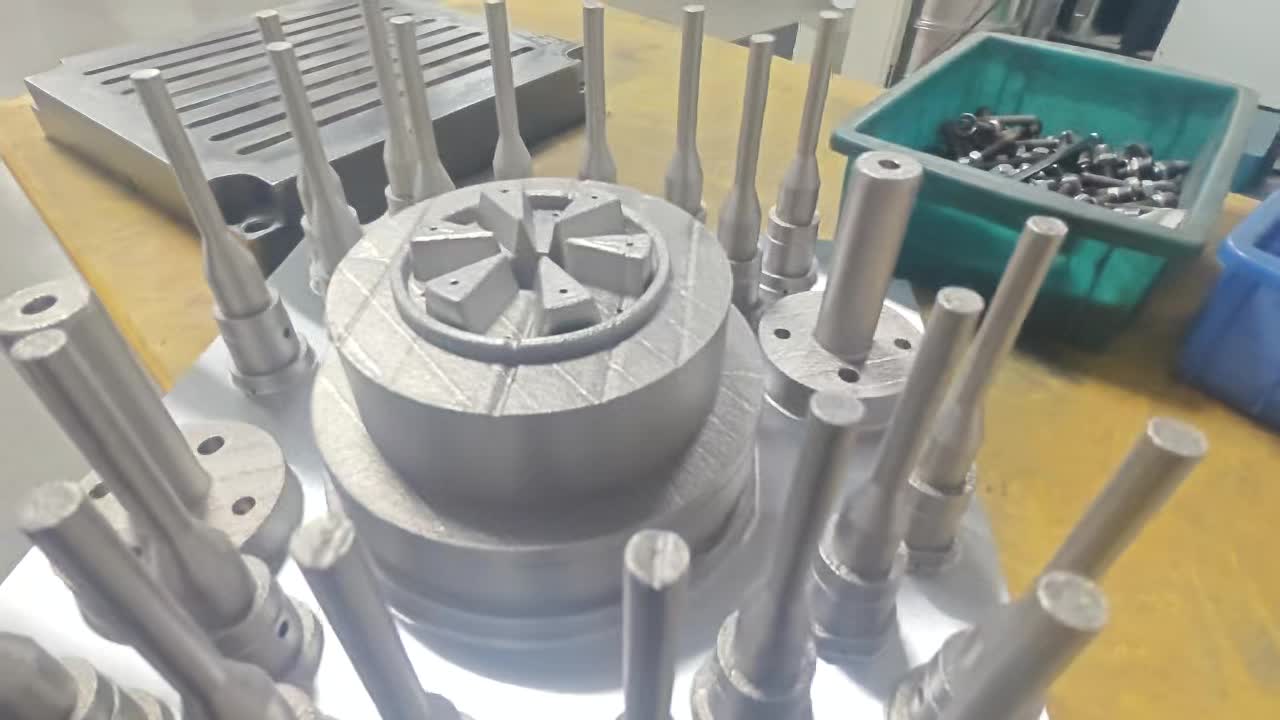
Retrofit Conformal Insert
- Replace one or more hot-spot inserts in an existing mold
- Mold base unchanged; only the insert is upgraded
- Lead time: 7–16 days
- Best for: single hot spots, deep cores, cylindrical features
- Cycle time reduction: 20–42% (on the cooled zone)
- Risk: low — insert can be swapped back if needed
New Mold with Conformal Inserts
- New mold base with conformal inserts in critical zones, conventional cooling elsewhere
- Best of both worlds: lower cost than full conformal, better than retrofit alone
- Lead time: 35–50 days
- Best for: complex parts with 2–4 critical cooling zones
- Cycle time reduction: 30–50% overall
- Risk: medium — new mold investment
Full Conformal Mold
- Entire cavity and core designed with AM conformal channels
- Maximum cooling uniformity across entire part surface
- Lead time: 55–70 days
- Best for: extreme geometry, highest-volume applications, maximum quality requirements
- Cycle time reduction: 40–55% overall
- Risk: high investment, highest return at scale
2. Decision Framework: Which Solution Fits Your Situation
Work Through These Questions
Do you already have a working mold with a cooling problem?
Yes → Start with Tier 1 (retrofit insert). Identify the hot-spot zone via infrared camera or Moldflow and replace only that insert. If the problem is in 3+ zones, evaluate Tier 2 for the next mold revision.
No (new mold) → Proceed to Q2.
What is your annual production volume?
<100,000 shots/yr → Conformal cooling has a long payback — use only if dimensional quality is the primary driver, not cycle time.
100,000–500,000 shots/yr → Tier 1 retrofit or Tier 2 hybrid. Tier 3 is hard to justify below 500K.
>500,000 shots/yr → Any tier is economically justified. Choose based on geometry.
How complex is your part geometry?
Simple (mostly flat, uniform wall thickness) → Conventional cooling may already be adequate. Run Moldflow to confirm cooling is the limiting factor before investing in conformal.
Moderate (some deep features, ribs, bosses) → Tier 1 targeted inserts at the deep features.
Complex (deep cores, curved surfaces, varying wall thickness) → Tier 2 or Tier 3 depending on volume.
Is your primary problem cycle time, part quality, or both?
Cycle time only → Conformal cooling is the right tool. Focus on cooling phase percentage (target: below 35% of total cycle).
Part quality only (warpage, sink marks) → Temperature uniformity is the goal; conformal cooling with parallel-branched channels. Simulation-validated design is critical.
Both → Full conformal or targeted inserts at the specific failure zones.
What is your timeline?
Urgent (under 3 weeks) → Only Tier 1 retrofit is achievable. Tier 2 and Tier 3 require new mold lead time.
Standard (4–8 weeks) → Tier 2 hybrid is achievable.
Planned (8+ weeks) → All options available; choose based on geometry and ROI.
3. Simulation: The Foundation of Any Conformal Cooling Solution
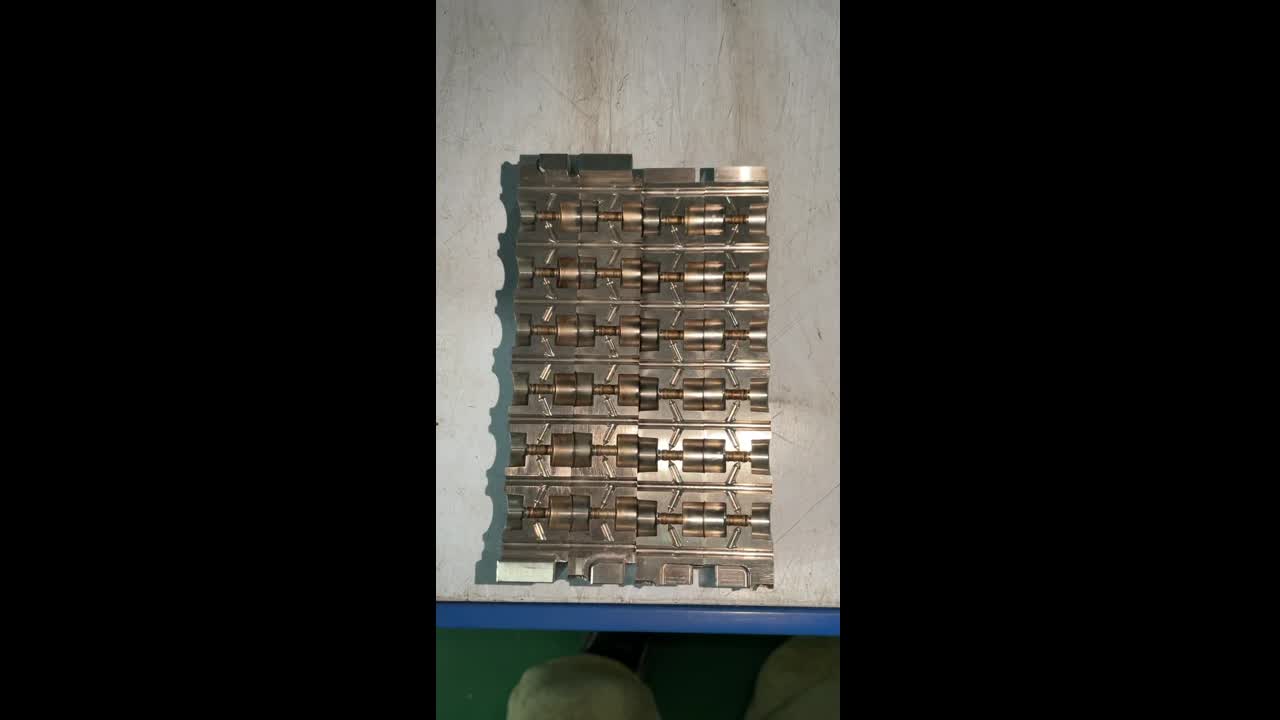
No conformal cooling solution should be specified without thermal simulation. Simulation serves two functions: it quantifies how much cycle time and temperature uniformity improvement is achievable (justifying the investment), and it defines where the channels need to go (preventing the wrong insert from being designed).
What Simulation Reveals
| Simulation Output | Decision It Drives |
|---|---|
| Cooling time as % of total cycle | Whether conformal cooling will deliver meaningful improvement. If cooling is already <30% of cycle, other phases are the bottleneck. |
| Temperature distribution at ejection | Identifies hot spots — specific zones where conformal inserts are needed. Often 1–2 zones drive 70–80% of the problem. |
| ΔT across part surface | Quantifies warpage risk. ΔT > 15°C typically produces visible warpage in flat sections. |
| Conformal vs. conventional comparison | ROI calculation input. Simulation output shows cycle time delta, which drives the payback calculation. |
| Optimal channel routing | Tells the AM designer where channels need to go, what diameter, and what pitch to use. |
Simulation Tools for Conformal Cooling
| Software | Best For | Conformal Cooling Capability |
|---|---|---|
| Moldflow (Autodesk) | Injection molding process simulation | Full cooling analysis, conformal channel modeling, warpage prediction |
| Moldex3D (CoreTech) | Injection molding simulation | 3D conformal channel simulation, thermal stress analysis |
| nTopology | AM-native design with simulation | Topology-optimized channel design, TPMS generation, FEA integration |
| ANSYS Fluent | CFD (coolant flow analysis) | Reynolds number validation, pressure drop calculation, heat transfer coefficient |
4. ROI Comparison: Four Production Scenarios
Scenario A: Packaging Cap (PP, 16-cavity)
Scenario B: Automotive Bracket (PA66-GF30)
Scenario C: Medical Device Housing (PC)
Scenario D: Electronics Housing (ABS, complex)
5. Conformal Cooling for Specific Problem Types
Problem: Excessive Cycle Time (Cooling Phase >40%)
This is the primary use case and the strongest ROI scenario. If your Moldflow shows cooling time is 40–60% of total cycle, you have significant improvement potential. Run a conformal simulation — most cases show 30–50% cooling time reduction, which directly translates to cycle time reduction at the same percentage. For a 50-second cycle, a 40% reduction means 20 fewer seconds per shot. At 600,000 shots/year, that is 3,333 hours of press time recovered annually.
Problem: Warpage or Dimensional Variation
Warpage is caused by non-uniform temperature distribution at ejection. A part with ΔT > 10–15°C across its surface will warp as hotter regions contract more during cooling. Conformal cooling addresses this by maintaining ±2–5°C uniformity across the cavity wall, versus ±10–25°C typical for conventional cooling. The right solution is simulation-guided channel routing that explicitly targets temperature uniformity — not just channel placement near hot spots.
Problem: Sink Marks at Thick Sections
Sink marks occur when the surface solidifies before the core cools — the semi-molten core pulls the surface inward. Conformal channels placed at D = 8–10 mm from the problem surface, with optimized pitch, extract heat faster than the part can accumulate it. Sink marks at bosses and ribs are among the most common problems solved by targeted retrofit inserts.
Problem: Weld Lines from Multi-Gate Fill
Weld lines form where two flow fronts meet. Conformal cooling alone cannot eliminate weld lines — that requires gate relocation. However, conformal cooling can improve weld line strength by maintaining cavity wall temperature above the material's flow temperature at the weld location, which increases weld line penetration depth and improves molecular bonding. This is a secondary effect, not the primary function.
Problem: Inconsistent Quality Across Cavities (Multi-Cavity)
In multi-cavity molds, thermal asymmetry between cavities causes cavity-to-cavity dimensional variation. Conformal cooling inserts in the thermally asymmetric cavities (typically those farther from the sprue or near hot runner manifold hot spots) bring those cavities into thermal balance with the rest of the mold. This is a targeted Tier 1 application with very fast payback.
6. What to Provide When Requesting a Conformal Cooling Solution
To receive an accurate quote and optimized channel design, provide these inputs to your conformal cooling supplier:
| Input | Format | Why It Matters |
|---|---|---|
| Part CAD (with wall thickness) | STEP or IGES | Required for simulation and channel routing geometry |
| Mold insert drawing | DXF or STEP | Defines pocket geometry for retrofit fit; required for dimensional matching |
| Part material + grade | e.g., PA66-GF30, ABS HF380 | Sets target cavity wall temperature, cooling time target, and ejection temperature |
| Current cycle time breakdown | Fill / pack / cooling / eject seconds | Identifies if cooling is actually the bottleneck |
| Annual production volume | Shots/year | Required for ROI calculation and solution tier recommendation |
| Problem description | Cycle time / warpage / sink marks / etc. | Guides channel routing priority and simulation objectives |
| Existing Moldflow / Moldex3D results | Temperature map at ejection | Accelerates channel routing and validates solution before manufacturing |
7. Implementation: From Decision to Production
Regardless of which tier you choose, implementation follows the same sequence:
- Problem definition and simulation (1–2 days): Confirm cooling is the bottleneck; quantify improvement potential; identify target zones.
- Channel design and structural validation (1–2 days): Design channels within printability constraints; FEA check for wall thickness and bend radii; confirm powder evacuation routes.
- Quote approval: Review cost, lead time, material selection, and performance guarantee (cycle time reduction range). Approve before printing.
- Manufacturing (3–5 days for Tier 1; 25–40 days for Tier 2/3): LPBF printing, stress relief, heat treatment, CNC finishing, CMM inspection, pressure testing.
- Delivery and mold integration (1–2 days): Install insert; connect cooling circuit; verify flow rate meets Reynolds number target.
- First article inspection (1 day): Run 50 shots; measure cycle time, part dimensions, and surface temperature; confirm results against simulation prediction.
8. Frequently Asked Questions
What are the main types of conformal cooling solutions?
Three tiers: (1) Retrofit inserts ($800–9,000, 7–16 days), replacing hot-spot zones in existing molds; (2) Hybrid new molds ($15,000–55,000, 35–50 days) with conformal zones and conventional cooling elsewhere; (3) Full conformal molds ($40,000–150,000+, 55–70 days) for maximum performance on complex geometry.
How do I know if conformal cooling will solve my problem?
Run a Moldflow or Moldex3D thermal simulation. If cooling time exceeds 35% of total cycle, or if part temperature at ejection varies by more than 10°C across the surface, conformal cooling will deliver measurable improvement. If your problem is related to injection pressure, venting, or material selection, conformal cooling may not help.
What production volume justifies conformal cooling?
Retrofit inserts: 200,000+ shots/year typically achieves payback within 6 months. Hybrid/full conformal molds: 500,000+ shots/year for reliable ROI. At 1M+ shots/year, conformal cooling is almost always economically justified.
How long does implementation take?
Retrofit insert: 7–16 days from approval to delivery. Hybrid mold: 35–50 days. Full conformal mold: 55–70 days. Emergency retrofit inserts for critical production lines can sometimes be expedited to 5–7 days.
Can conformal cooling be added to an existing mold?
Yes, via Tier 1 retrofit inserts. The mold base stays; only the hot-spot inserts are replaced with 3D-printed conformal versions. This works when inserts are bolt-in components with standardized pocket geometry. Not all mold designs support insert replacement — check before designing a solution.
Find the Right Conformal Cooling Solution
Share your part, material, and production volume. MouldNova's team will run the simulation, recommend the right tier, and provide a quote within 24 hours — at no charge.
Get a Free Engineering Review →